
The Gospel Jesus Preached
Introduction
If someone gave you 30 minutes to tell them the Gospel, would you need to explain why Jesus died on the cross?
A: I anticipate most people's response would be "Yes".
Have you ever wondered how Jesus shared the Gospel? After all, Jesus had not died on the cross for the forgiveness of our sins and the Holy Spirit had not been poured out to fill us with God’s presence.
This DBS is to help us discover what Gospel Jesus preached.
[Be warned! The journey is difficult, shocking and perilous. Difficult, because we are so conditioned to understand the Gospel through the lens of the cross it is difficult to conceive of the Gospel in any other way. Shocking, because the central theme of all our preaching and worship – the Cross - is missing from the Gospel Jesus preached. And perilous, because to accept and adopt the Gospel Jesus and the Apostles preached requires the abandonment of much that we have been taught about the Gospel.]
Jesus’ Gospel
In groups look at the following scriptures: What do they tell us about people and God and the Gospel?
Mark 1:15 Jesus said, “The time has come. The kingdom of God is near. Repent and believe the good news!”
A: People were expecting the kingdom but didn't believe it had come. God had promised His Kingdom on earth. The Gospel is the announcement that God’s Kingdom is near.
Luke 10:1,9 After this the Lord appointed seventy-two others and sent them two by two ahead of him to every town and place where he was about to go … Heal the sick who are there and tell them, ‘The kingdom of God is near you.’
A: People are sick because of Satan's kingdom. God demonstrates the new kingdom through healing. The Gospel is the pronouncement that the kingdom is near.
Luke 4:18-19 Jesus said, “The Spirit of the Lord is on me, because he has anointed me to preach good news to the poor. He has sent me to proclaim freedom for the prisoners and recovery of sight for the blind, to release the oppressed, to proclaim the year of the Lord’s favour.”
A: People are poor, imprisoned, blind and oppressed in Satan's kingdom. God sent Jesus to set people free. The Gospel is the announcement and implementation of freedom in God's kingdom.
How might we express the gospel based on these scriptures?
A: God's long promised Kingdom on earth has come to us through Jesus. We are invited to become part of His Kingdom and receive freedom.
Can you see this same gospel in the great commission?
Matthew 28:18-20 Jesus said, “All authority in heaven and on earth has been given to me. Therefore go and make disciples … and surely I am with you always, to the very end of the age.”
A: "all authority" refers to Jesus as King. "To the very end of the age" refers to the change of era, or change of kingdoms, where Jesus is now the eternal King. To make disciples we need to proclaim Jesus as the King who is forever with us.
John’s Gospel
John’s most concise Gospel summary is found in his first letter. What does this tell us about people and God and the Gospel?
1 John 1:5 This is the message we have heard from him and declare to you: God is light; in him there is no darkness at all.
A: People are deceived, misguided and oppressed (darkness). God is entirely light and truth. If there is a place where there is only light and no darkness at all, that is truly good news.
In groups look at John’s gospel introduction (1:1-18) and note down everything that is “good news” and try to summarise the gospel:
John 1:1-5, 1:6-9, 1:10-13, 1:14-18. (You might also like to look at John 3:16-21).
A: The light (Jesus) shines in our darkness. That light came into our world in the person of Jesus. We become children of God through believing that Jesus is the eternal light. The gospel books are eye witness accounts of the glory of Jesus, beyond that of any man. Jesus makes God known to us with new authority and clarity. He brings grace and truth to us instead of law.
This is a very different expression of the Gospel from that recorded in the other three gospels. How would you describe this difference?
A: John puts more emphasis than the other gospel writers on who Jesus is and talks about Light instead of God’s Kingdom.
John’s was the last of the gospels to be written, towards the end of his long life, after 50 years of proclaiming the Gospel and reflecting on its meaning. The Gospel was being proclaimed in deeply pagan places where the Kingdom of God had no cultural meaning. John appears to have translated the Gospel from its Jewish cultural origins into a Greek pagan culture.
What has “The time has come…” been translated into?
A: No one has ever seen God, but the one and only Son, who is himself God has made him known.
What has “God’s Kingdom is near” been translated into?
A: Light has come.
What has the previous kingdom of Satan been translated into?
A: Darkness
What has “Repent and believe the Good News” been translated into?
A: To all who did receive him, to those who believed in his name, he gave the right to become children of God
How close is John’s Gospel to what Jesus gave to Paul as seen here:
Act 26:18 Jesus said, “I am sending you to them to open their eyes and turn them from darkness to light, and from the power of Satan to God, so that they may receive forgiveness of sins and a place among those who are sanctified by faith in me.”
A: John's gospel is framed in the same terms that Jesus used in giving the gospel to Paul.
Paul’s Gospel
When we come to Paul we have to take care to distinguish between the theology he wrote about in his letters to believing churches, and what he preached to unbelievers. In this study we are trying to discover the gospel Paul preached to unbelievers.
What does the book of Acts tell us about the Gospel Paul preached?
Acts 19:8 Paul entered the synagogue and spoke boldly there for three months, arguing persuasively about the kingdom of God.
Acts 28:31 Paul proclaimed the kingdom of God and taught about the Lord Jesus Christ—with all boldness and without hindrance!
A: Paul preached the Kingdom of God, the same as Jesus did.
We have discovered a remarkable unity across the four Gospels and Acts showing us what the Gospel was that Jesus and the Apostles preached to unbelievers. It was known as “The Gospel of the Kingdom”.
Explanations of how the cross makes salvation possible
The gospels record many occasions when Jesus told his disciples that he would die and rise again. But we have not seen any mention of the cross!
John 1:29 The next day John saw Jesus coming toward him and said, “Look, the Lamb of God, who takes away the sin of the world!”
Could Jesus have explained His role as “the Lamb of God who takes away the sin of the world” as part of His Gospel message from the beginning?
A: Yes. John the Baptist described Jesus in this way.
After the resurrection Jesus explained the theology of His death and resurrection in private conversation with trusted disciples:
Luke 24:26-27 Jesus said, “Did not the Messiah have to suffer these things and then enter his glory?” And beginning with Moses and all the Prophets, he explained to them what was said in all the Scriptures concerning himself.
Is it conceivable that when the gospels were written, the authors did not understand the role of the cross in salvation?
A: No. Jesus explained it. Paul clearly understood it and shared his understanding with the other apostles at the council of Jerusalem. They were in agreement. All the gospels were written after that council.
Is it a terrible accidental omission that the gospel writers offer no explanation of how the cross deals with our sin and makes salvation possible?
A: That is not conceivable. It must be intentional.
Forgiveness in the Gospel Message
Luke 24:47 Jesus said “Repentance for the forgiveness of sins will be preached in My name to all nations.”
We know that Jesus had to die on the cross for our sins to be forgiven. What explanation does Jesus give for forgiveness?
Matthew 9:2-6 Some men brought to him a paralyzed man, lying on a mat. When Jesus saw their faith, he said to the man, “Take heart, son; your sins are forgiven.” At this, some of the teachers of the law said to themselves, “This fellow is blaspheming!” Knowing their thoughts, Jesus said, “Why do you entertain evil thoughts in your hearts? Which is easier: to say, ‘Your sins are forgiven,’ or to say, ‘Get up and walk’? But I want you to know that the Son of Man has authority on earth to forgive sins.” So he said to the paralyzed man, “Get up, take your mat and go home.”
A: Jesus has the authority to forgive. That is all we need to know.
The “Four Spiritual Laws”
The “Four Spiritual Laws” were devised in the 1950’s by Crusade for Christ as an easy way to share the gospel. They are four powerful biblical truths:
1: God loves you and has a wonderful plan for your life.
2: Human sin has separated us from God and His plan for us.
3: Jesus is God’s provision for human sin, through whom we can know God’s love and plan for us.
4: We must each invite Jesus to be our Saviour and Lord.
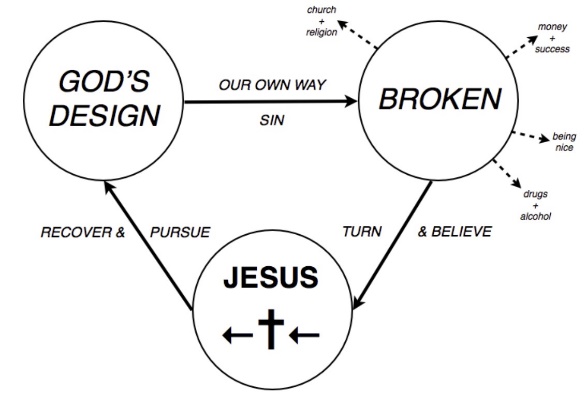 The Four Spiritual Laws form the basis of countless evangelistic tracts and popular illustrations such as the Bridge Illustration and The Three Circles.
This approach is a reasoned explanation of the need for salvation and the mechanism of salvation. It puts explaining sin and its remedy at the heart of the gospel message.
However, we have discovered that this is not the way Jesus, or the apostles, shared the Gospel. What reason does Paul give for sticking to the Gospel Jesus preached:
1 Corinthians 4:20 “The kingdom of God is not a matter of talk but of power.”
A: Explaining the gospel reduces it to teaching and believing in a doctrine, instead of proclaiming a life changing encounter.
Proclaiming the Gospel
What have we learnt from Jesus about sharing the Gospel?
Take feedback from the groups.
When I started to learn from Jesus about sharing the gospel I felt like he had taken away a nice easy tool (the bridge illustration) and left me with a really hard to communicate idea of the Kingdom of God. I spent months trying to come up with a Kingdom version of the Four Spiritual Laws, and was really pleased when I eventually boiled it down to three words. I’m not going to tell you those three words because I have never used them. I discovered a much better way to share the gospel. I am ashamed to admit that it took me so long to discover this truly amazing and powerful way of sharing the gospel.
I let Jesus share the gospel:
Mattew 11:28-30 Jesus said, “Come to me, all you who are weary and burdened, and I will give you rest. Take my yoke upon you and learn from me, for I am gentle and humble in heart, and you will find rest for your souls. For my yoke is easy and my burden is light.”
There are many other Gospel stories we can use. They are the sword of the spirit. Let’s use them.